Capacitive Proximity Sensors

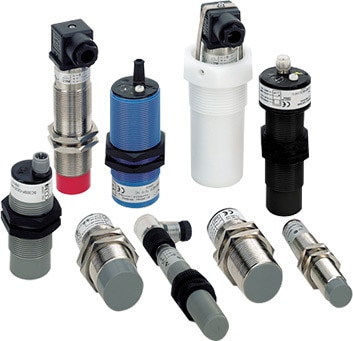
Shielded and Unshielded Models
NPN or PNP

from $82.45
Shielded and Unshielded Models
NPN or PNP

from $98.80


What are Capacitive Sensors?


Capacitive Proximity Sensors are used widely as limit switches which are sensitive to almost all types of materials including liquids, paper, plastics, and more. These devices function so that any material - even non-metallic materials - in the proximity of the active surface (sensing area) will produce oscillations that lead to a change of state. Unlike an inductive proximity sensor that oscillates until the target is present, a capacitive proximity sensor oscillates when the target is present.

Capacitive sensors contain an oscillator transistor in the front section. The R-C (resistor-capacitator) oscillating circuit is influenced by variations in capacity when any material - solid or liquid (water, wood, metals, coffee, powders, etc...) - comes into contact with the active surface of the sensor. These sensors use the variation of capacitance between the sensor and the object being detected. When the object is at a pre-set distance from the sensitive side of the sensor, an electronic circuit inside the sensor begins to oscillate. The rise or the fall of such oscillation is identified by a threshold circuit that drives an amplifier for the operation of an external load. A screw placed on the backside of the sensor allows regulation of the operating distance.


How are Capacitive Sensors Used?

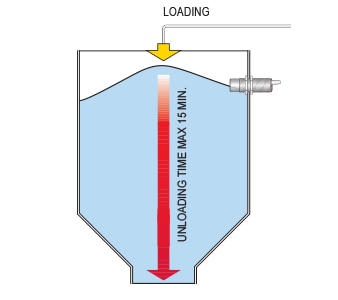
Capacitive sensors are widely used as proximity switches that are sensitive to all types of materials and as limit controls that sense the minimum and maximum levels of liquids, powders, granules, etc... in silos and various containers. Capacitive sensors can also be used for sensing or counting metallic and non-metallic objects.

Capacitive sensors are widely used in applications where the material being controlled is not necessarily metallic. Capacitive sensors can be used to:
• Control the minimum and maximum level of liquids, powdered products, granules, etc
• Count or detect metal and/or non-metal parts
• Control solid/liquid presence inside packaging/non-metallic containers
• Control height of a paper stack
• Control the breakage in reels of nonmetallic material (e.g. paper, plastic, etc.)
• Control liquid flow or liquid filling
• Control sorting and counting of the automatic presence of metallic and non-metallic items


Capacitive Sensor Application Examples


Contact Level Control for Solids or Liquids


Level Control for Non-metallic Containers


Level Control for Metal Containers Using Plastic or Glass Windows


Sensing Solids or Liquids Inside Non-metallic Containers

Controlling the Height of a Paper Stack


Liquid Flow Control

Filling Control


Level Control with Delayed Sensor

Control in Tanks with Temperatures between -328° and 482°F (-200 and 250°C)


Controlling the Breakage in Reels of Non-metallic Material
(Paper, Plastic, Etc.)

Automatic Counting and Sorting of Metallic and Non-metallic Materials


What Type of Capacitive Sensor to Choose ?

When choosing a capacitive sensor, the sensing object material (such as the form and composition) should be considered. Additionally, the thickness and mass of the material should be considered.

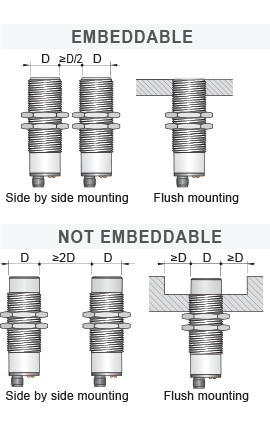
If possible, it is recommended to use a non-embeddable model (not mounted flush with the surface) to take advantage of a greater sensitive field. This means that the sensor is suggested to not be set to the maximum where it would be more prone to effects from temperature variations, humidity, powder deposits, etc. If it is necessary to install the sensor flush with the surface, it is again advised to not make the setting too close to the maximum sensing distance.

The main difference between the shielded and unshielded types of sensors is that, at equal intervention distances, the shielded sensor requires a sensitivity of about double that of the unshielded, and therefore can function under more critical conditions.


Where are Capacitive Sensors Used?

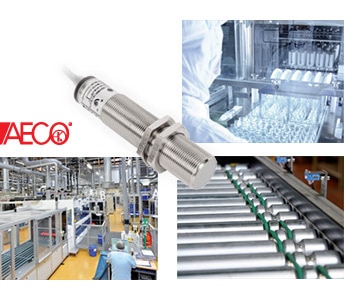
Capacitive sensor technology can be applied to a variety of products and mechanical, industrial, or technological applications. Common uses can be seen in:

• ATM’s
• Vending machines
• Medical devices
• Industrial and automotive equipment
• Conveyor systems


Sensitivity Adjustment

Adjustments to the sensors’ sensitivity should be carried out when they are connected in the definite operation position. Adjust the sensor at the intermediate position between the minimum and maximum values.

• If adjustment is very fine, humidity can cause unwanted variation
• Sensing range is determined in respect to target materials/objects
• Sensitivity increases when trimmer is rotated clockwise and decreases when rotated counterclockwise.
• If mounted on a metallic support, must be grounded during adjustment to avoid altering sensing distance